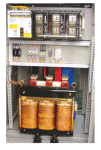
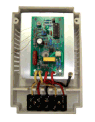
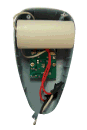
A power saving system is a device that can help save power by reducing unnecessary power loss, and can be divided into the items as below depending on the installation methods and the saving technologies.
Installation method
Serial
In parallel
Saving technology
Harmonic improvement
Voltage drop
Power factor improvement
Manufacturer
Enertech
D, B, H and others
C and U
The principle of
power saving
Reduce the active power (kw) by decreasing the power loss (Iron loss and copper loss) through eliminating Harmonic and Unbalance
Staged tab adjustment can help control the output voltage, helpful decreasing the output of a facility, and reducing the active power (kw).
Reduce the inactive power (Kvar) in order to get a discount for the basic electric charges when the power factor is 0.9 or higher.
Core technology and
key part
Auto Transformer
(Zigzag winding method)
Semiconductor IC (Voltage control algorithm)
Condenser wiring in parallel (Power factor algorithm)
Power quality improvement function
Power quality improvement function
Improvement related to harmonic, unbalance and power factor
Improvement of power factor
Reduction of active power
Reduction of active power
Good
Fair
Reduction of inactive power
Reduction of inactive power
Fair
Good
Voltage variable range
Voltage variable range
Voltage ratio 4%
3-staged tap control (4%, 5%, 8%)
Current compensation function
O
X
O
Product life span
15~20 years
5~10 years
3~5 years
Expected
effects
Lighting
O
O
X
Driving power
O
X
O
Electric heat
O
O
X
Average power saving rate
5~10%
3~8%
2~5%
Investment pay-off time
3~5 years
4~8 years
5~10 years
Strong points
- Safety, durability, efficiency.
- For a complex load
- Compact and light
- Price competitiveness
Weak points
- Delivery time
- Reduction of illumination and
efficiency.
- Moisture
- resistance and dust-protection
- A fire at the condenser.
- Impossible to reduce active
power